By Allan Kai
For nearly two years, Kenya's aquaculture industry has found itself at the center of one of the country's most contentious blue economy policy debates. What began as an attempt by the national government to standardize regulation and increase revenue from commercial fish farming quickly evolved into a constitutional dispute involving fish farmers, county governments, industry associations and legal experts.

Fish trader dependant on commercial aquaculture companies along Lake Victoria. Photo: Victory Farms' LinkedIn
At the heart of the controversy are two financial measures introduced under the Fisheries Management and Development (Aquaculture) Regulations, 2024 (Legal Notice No. 126): a KES 50,000 annual license renewal fee for commercial aquaculture operators and a 5 per cent ad valorem levy on the value of all landed catch from public waters.
Supporters say the regulations will strengthen oversight of a rapidly growing sector and improve compliance with fisheries laws. Critics argue they impose an excessive financial burden on producers, threaten investment and risk making Kenyan fish less competitive in regional markets.
The legal uncertainty surrounding the regulations finally came to an end in June 2026 when the High Court dismissed a constitutional petition challenging the rules, effectively allowing the government to begin full implementation.
The Genesis
The regulations were gazetted in 2024 by Cabinet Secretary for Mining, Blue Economy and Maritime Affairs, Ali Hassan Joho, as part of broader efforts to modernize fisheries management and strengthen governance within Kenya's blue economy.

Cabinet Secretary for Mining, Blue Economy and Maritime Affairs, Ali Hassan Joho during the recently concluded Our Ocean Conference held earlier this month in Mombasa. Photo: Courtesy
Among several regulatory changes, two provisions immediately attracted industry attention:
· Commercial aquaculture operators would be required to renew their operating licenses annually at a cost of KES 50,000.
· Operators would also pay a 5 per cent ad valorem levy based on the market value of fish harvested from public waters, including cage farming operations on Lake Victoria.
Government officials argued that the new framework would improve regulation of commercial fish production, generate revenue for fisheries management and research, and formalize a sector where tax compliance had historically remained low.
Pushback
The regulations immediately met resistance from commercial fish farmers, particularly operators on Lake Victoria.
The Lake Victoria Aquaculture Association (LVAA) filed a constitutional petition challenging the legality of the regulations before they could take effect. The association argued that government had failed to conduct adequate public participation before introducing the new fees, violating constitutional requirements for stakeholder consultation.

Busia and Kisumu county governors H.E. Paul Otuoma and H.E. Prof. Anyang' Nyong'o during the Lake Victoria Aquaculture Forum in 2024, flanked by members of the LVAA. Photo: LVAA Instagram
The association further argued that the charges would significantly increase production costs for commercial farmers at a time when the industry was already struggling with rising feed prices, disease outbreaks and competition from imported fish.
LVAA maintained that applying a flat license fee regardless of the size of an enterprise disproportionately affected small and medium-sized commercial farms, many of which operate on relatively thin profit margins.
High Court Freezes the Regulations
In December 2024, only days before the regulations were scheduled to take effect on 1 January 2025, the High Court issued conservatory orders suspending implementation.
The temporary injunction halted enforcement of the license fee and levy while the constitutional petition was heard.
The ruling created immediate uncertainty across Kenya's aquaculture sector, leaving investors, fish farmers and county governments waiting for legal clarity on whether the regulations would ultimately survive judicial scrutiny.
Government Task Force Formed
Rather than proceeding with implementation while the matter remained in court, Cabinet Secretary Ali Hassan Joho announced a temporary suspension of the regulations and established a 12-member stakeholder task force.
The task force comprised representatives from the Ministry, the Council of Governors, the Lake Victoria Aquaculture Association, and other industry stakeholders.
The committee was mandated to engage industry players, review concerns raised by farmers and recommend possible adjustments that could build broader consensus around implementation.
The move was viewed by many observers as an attempt to reduce tensions while allowing dialogue between government and the private sector.
However, industry groups maintained that meaningful consultation should have preceded publication of the regulations rather than occurring after legal action had already been filed.
The Industry's Economic Concerns
One of the strongest critics of the regulations has been Caesar Asiyo, President of the African Aquaculture Business Leaders Network (AABLN).

Caesar Asiyo, President of the African Aquaculture Business Leaders Network (AABLN). Photo: AABLN LinkedIn
Asiyo argued that the combined impact of the annual license fee and the ad valorem levy would significantly increase production costs for Kenyan fish farmers.
According to him, these higher operating costs could ultimately be passed on to consumers through higher fish prices while simultaneously reducing the competitiveness of locally produced fish.
He warned that more expensive locally farmed tilapia could create greater market opportunities for cheaper imported frozen fish, particularly imports from China.
Industry representatives have also questioned the fairness of applying a fixed annual license fee to operators of vastly different sizes.
Large commercial producers may absorb the additional cost with relatively little difficulty, they argue, but smaller commercial enterprises could struggle to remain profitable, potentially slowing investment and expansion within the sector.
The Devolution Debate
The dispute extended beyond industry economics and into questions about constitutional division of powers.
The Council of Governors expressed concern over what counties viewed as an overlap between national and county government mandates.
County governments already issue several business permits, cess charges and trading licenses related to fisheries and aquaculture.
Policy analyst Kizito Wangalwa argued that introducing additional national licensing requirements risks creating multiple layers of taxation for businesses already paying county charges.

Policy analyst Kizito Wangalwa. Photo: LinkedIn
Critics therefore questioned whether commercial aquaculture licensing—particularly for operations located on private land—should remain primarily a county government responsibility under Kenya's devolved system.
Supporters of the regulations, however, maintained that public-water aquaculture, fisheries management and conservation fall squarely within the mandate of the national government.
High Court Decision
The constitutional challenge reached its conclusion in June 2026 when the High Court dismissed the petition filed by the Lake Victoria Aquaculture Association.
The judgment effectively lifted the conservatory orders that had blocked implementation for almost eighteen months.
The Court reached several key findings.
First, the judge ruled that the Cabinet Secretary acted within powers granted under the Fisheries Management and Development Act, which expressly authorizes the Cabinet Secretary to regulate aquaculture, prescribe licensing conditions and impose fees.
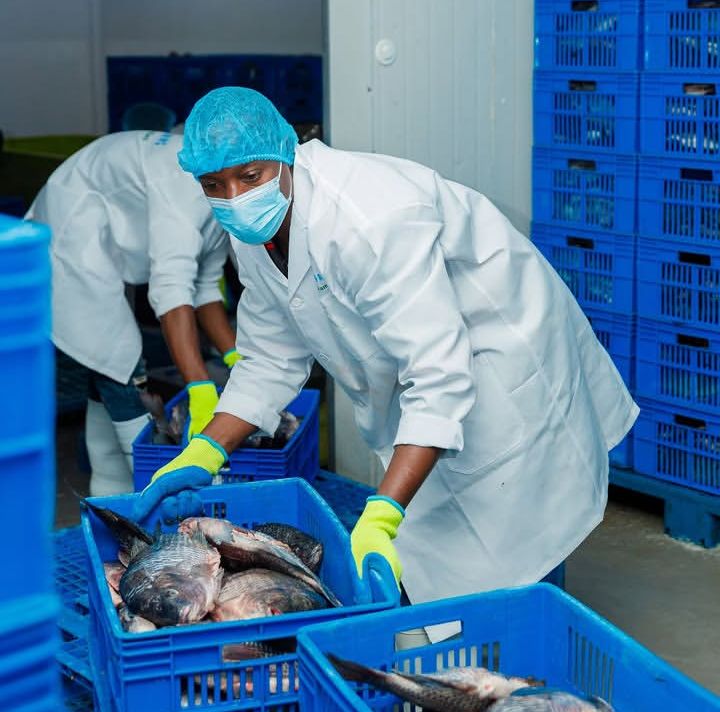
Fish processing at a commercial aquaculture processing plant in Lake Victoria. Photo: Courtesy
Secondly, the Court rejected arguments that the regulations violated constitutional principles of devolution, finding no unlawful encroachment on county government functions.
The Court also found insufficient evidence that the regulations violated constitutional rights.
An important consideration was the existence of exemptions within the regulations that exclude non-commercial and subsistence small-scale fish farmers from paying the KES 50,000 annual license fee.
With the petition dismissed, the national government is now legally free to fully implement both the annual licensing fee and the ad valorem levy.
Compliance Versus Competitiveness
The debate surrounding the regulations reflects a broader policy challenge facing Kenya's blue economy.
On one hand, government seeks to formalize a rapidly growing commercial industry that has historically experienced relatively low regulatory and tax compliance.
Previous analyses by the Kenya Revenue Authority (KRA) indicated that only a small proportion of fisheries operators were registered for tax purposes or consistently complied with existing obligations.
From this perspective, the regulations provide government with stronger oversight while creating additional revenue that could support fisheries research, resource management and sector development.
On the other hand, industry groups caution that increased regulatory costs may reduce competitiveness precisely when Kenya is seeking to expand domestic aquaculture production and reduce dependence on imported fish.
Economic analysts note that if farmers transfer the additional costs to wholesalers and retailers, consumers could ultimately face higher fish prices.
Blue Radio Kenya.
Allan Kai is a Fisheries and Conservation reporter for Blue Radio. He brings a wealth of experience in marine and fisheries reporting, having collaborated with various media houses and environmental organizations. Allan has a proven knack for crafting impactful stories that connect local communities with nature. For inquiries, please contact him at allankaigari@gmail.com.