
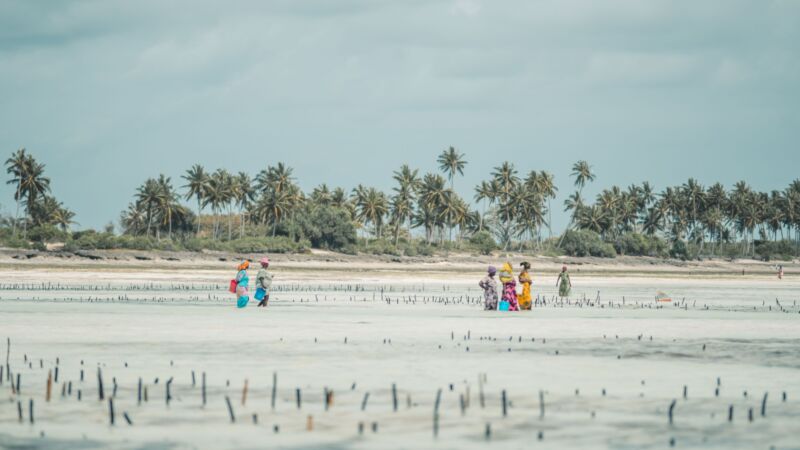
By Patrick Chiriba & Cate Mukami
With a torch in hand, she crouches on the sand picking through a pile of shells she has been collecting for hours.
The thunderous clap of the sea as the waves violently hit the shore, occasionally sends a chill down her spine. It is in this ruthlessly powerful Indian Ocean that her husband died years back, while struggling to eke out a living for his family.
Every night, Mama Margaret, ventures into the sea praying and hoping that the tides would be merciful. The widow, who lives at Kanamai, Kilifi County, wades into the dark sea at around 10 O’clock. She crawls out around 2 O’clock.
She precariously picks cowrie shells off the reef by torchlight. A good night, she says, yields two kilos. Buyers pay between Ksh. 40 and Ksh .70 a kilo, with a smiling night bringing shells worth Ksh. 80 to Ksh. 140.
Payments only come after the shells have been left to rot, washed and dried in the sun. Sometimes, buyers pay less because they are not shiny enough.
Margaret’s most frightful moments come whenever her school-going daughter, joins her in the same waters that took her father’s life.
With a pensive look, she says: “There is nothing helpful we get from the government. If the government was helping us, my daughter would not be in the sea with me at night.”
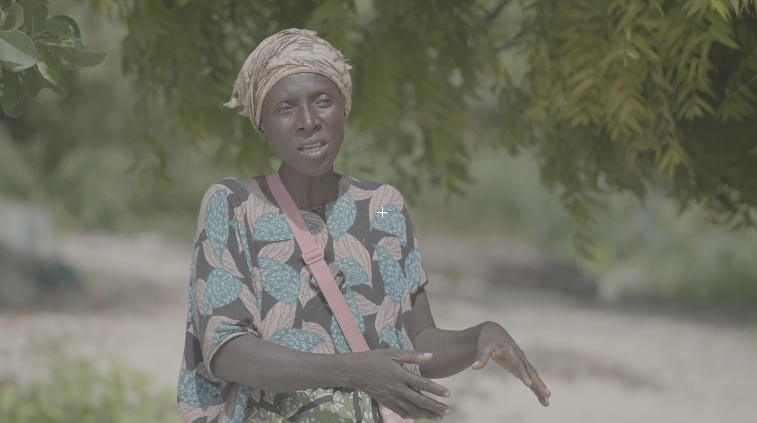
Mama Margaret at the Kanamai beach says at night says a good night yields about two kilos
Her reflective look into empty space, is as deep as the distance between promises made by the national Blue Economy and reality lived by women in Kilifi County. Women, waiting upon dreams, desires and benefits yet to come.
Women are everywhere in Kilifi’s fish economy. They dominate trading and processing. They make up nearly all the cowrie collectors. They constitute about 80 per cent of one fish-farming group we visited.
Yet, women are largely absent in spaces where money and key decisions play out. You rarely find them in the arenas of: boats, engines, cold storage, grants and trainings.
This loud absence occurs despite the law giving women a seat. The 2024 Beach Management Unit (BMU), Regulations bar executive committees from having more than two-thirds of one gender.
The Kilifi BMU’s barely meet that. Women are roughly 16 per cent of the members at Kanamai BMU, and derive very few benefits.
Cowrie gleaners, almost all women, are not counted in national fisheries statistics, and the legal status of their trade is unclear.
In official records, freezers, cooler boxes, loans and training programmes reach women through groups, proposals and meetings. However, on the ground, women at Kanamai and Kijangwani say they never heard of them or never received them. Officials insist that distribution is fair.
Women in freshwater aquaculture, the sector the government’s plan treats as its main growth engine, say promised training never comes.
The promise on paper
On February 26 2026, the government launched the National Blue Economy Strategy 2025 - 2030, which aims to lift annual earnings from Ksh. 40 billion to Ksh. 350 billion by 2030.
Cabinet Secretary Ali Hassan Joho says Kenya had chosen to treat the blue economy “not as a slogan but as a pillar of our development strategy”
President William Ruto, speaking in Homa Bay in May 2025, described the goal as a; “thriving, inclusive, and sustainable blue economy”. His women described women and youth are central to the strategy.
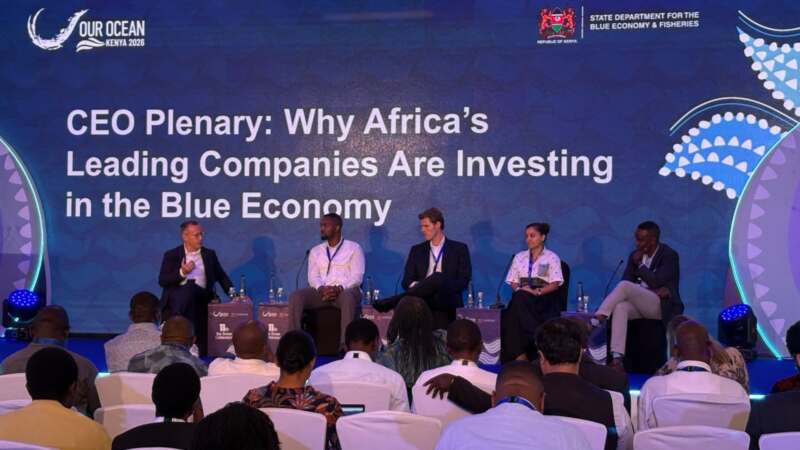
President Ruto told delegates at the Our Ocean Conference in Mombasa in June 2026, that they had not come: “to add our names to a longer list of promises”.
In a March 2026 interview, Blue Economy and Fisheries Principal Secretary Betsy Muthoni Njagi, captured the powerful figures of the Blue economy. It has grown from; 168,424 tons of fish worth Ksh. 39.6 billion in 2024; about 69,900 capture fishers and 65,452 fish farmers; and 1.2 to 1.5 million people across the value chain.
She said her ministry had moved: “from rhetoric to reality”, and would provide among other tools, operational landing sites and cold-chain infrastructure.
She said her ministry will invest in Women in the Blue Economy programme, by providing them with 1,490 jobs.
CS Joho’s predecessor, Salim Mvurya, told Parliament in 2024 that the programme runs from February 2022 to November 2026, and that Cabinet had approved a Kenya Fisheries Policy 2023 to mainstream gender equity.
On the coast, a major vehicle has been the World Bank-financed Kenya Marine Fisheries and Socio-Economic Development project (KEMFSED), a US$100 million credit approved in March 2020.
The legal anchor is the Fisheries Management and Development Act, 2016 (No. 35 of 2016), which sets out to uplift the living standards of fishing communities, encourages users’ participation in management, and lets the Cabinet Secretary make regulations for community-based BMUs.
We took a deep look into the sector to see how much meat, dressed up in all these projects and policies, reached the women who do the bulk of the work.
The law gives women a seat, then sets conditions to it
BMUs are the local bodies that co-manage landing sites with the government.
Under the 2024 BMU Regulations, an executive committee of up to 15 must draw 30 per cent of its membership; from boat owners, 30 per cent from crew, 30 per cent from fish traders and 10 per cent from “others”, and no more than two-thirds of it may be of one gender.
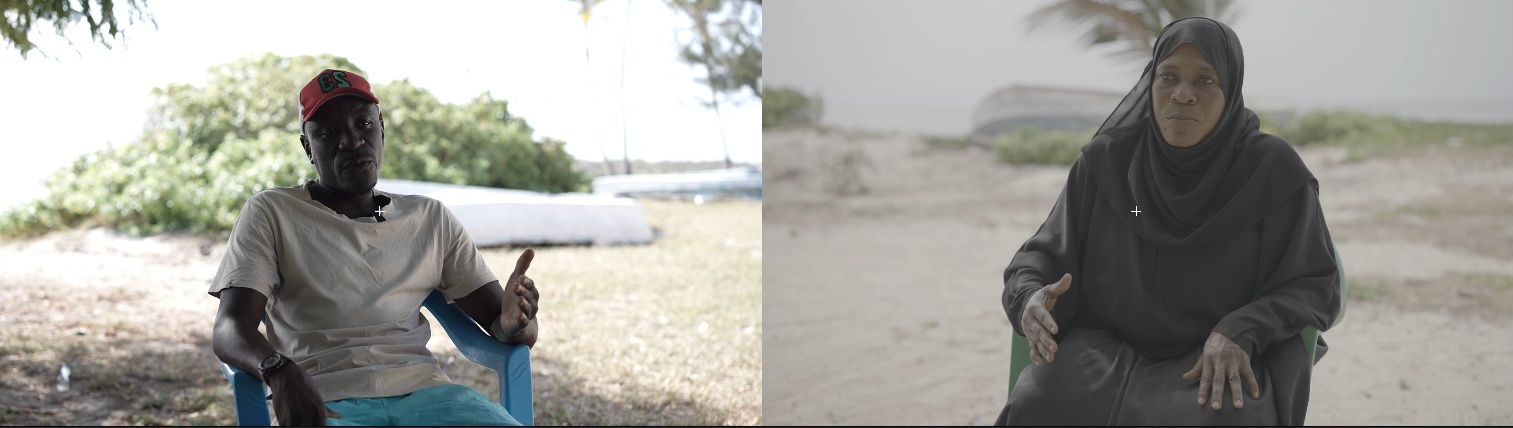 Gilbert Nzai and Bidala Rashid say women are well represented in the BMU structures
Officials we interviewed call this “30 per cent women”; in the text it is a one-third floor.
On that measure, the BMUs we visited comply. Kanamai BMU’s vice-chair, Bi Dala Rashid, says her 13-member committee has five women, or 38 per cent.
Gilbert Nzai, chair of Kuruwitu BMU and of the KAMAMKUKI Joint Co-Management Area (JCMA), says six of about 15 committee members are women, including his deputy and treasurer.
Dishon Murage, technical adviser at Oceans Alive, says some Kilifi BMUs approach 50 per cent.
But a seat on a committee is not the same as a share of the benefits. Bi Dala said Kanamai BMU has 585 members, of whom 92 are women, about 16 per cent.
Murage describes the early years of the 30 per cent rule candidly. He says that many women elected to BMU posts, then were “there to be seen”. They had no power to decide, a pattern he says is changing slowly. He however argues that: “We are not yet there but we are on the right path”.
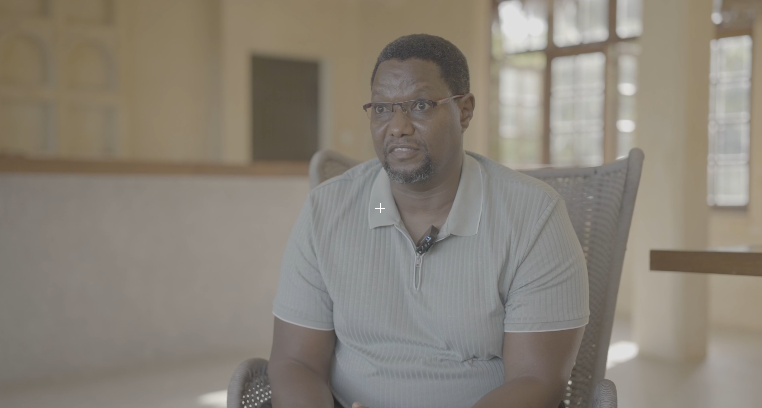
Dishon Murage says income in fisheries follows ownership of boats, engines and gear, and calls it “not an equal playing field”
The Regulations also contain two details that matter for the women we interviewed.
Shell collectors are filed under “others”. The definition of “others” lists net repairers, boat builders, engine repairers, cage and mariculture farmers, processors and shell collectors.
Women who collect cowries therefore compete for roughly one in ten committee seats with every other non-fishing trade.
Leadership has an education gate. Candidates must be literate; secretary and treasurer need at least a secondary school certificate, and so does the chair unless no one else qualifies, then a primary school certificate will do.
Candidates must also hold a certificate of good conduct and have no arrears of BMU fees.
County fisheries officer Teddy Kingi told us most fishers and fish traders are “class four dropouts”, with few having reached Class 8 or Form 4.
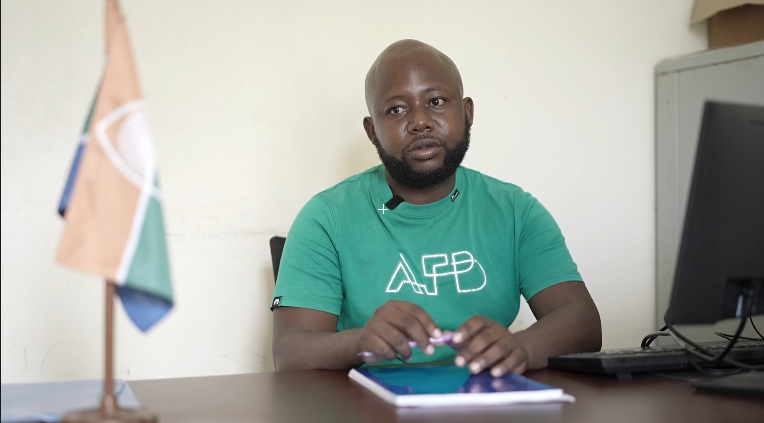
Teddy Kingi points out the issue of illiteracy among some members of the fishing community.
The rules apply to everyone, but they filter hardest on women.
The arithmetic of a night tide
The interviews give enough figures to price the work. Collectors described yields from a quarter-kilo on a daytime tide to about two kilos on a good night, and prices of Ksh. 40 to Ksh. 70 a kilo.
These are our calculations from those figures:
|
Haul |
Gross value at Ksh. 40 -70/kg |
|
Good night tide, about 2 kg |
Ksh, 80 - 140 |
|
Half to one kilo (Saumu’s typical day) |
Ksh. 20 - 70 |
|
Daytime tide, about ¼ kg |
Ksh. 10 - 18 |
According to the Fisheries Management and Development (Marine Fisheries), Regulations, 2024 (Second Schedule), the national annual license for an artisanal fisher is Ksh. 500.
Others quoted other figures: Nzai says collectors pay Ksh. 500 to register with a BMU and Ksh. 200 to renew. Some collectors who earn about Ksh. 200 in a day. Still has to pay Ksh. 350 or 500 for a license.
Fish trader Salama Rajab says registration costs Ksh, 850 and renewal Ksh. 550. Bi Dala says fishers pay Ksh. 550.
The statutory Ksh. 500 equals four to six of the best nights earnings. Therefore, Salama’s Ksh. 850 registration, equals six to eleven times before the buyer’s deductions.
The differences between the figures may reflect BMU fees on top of the statutory license.
“We struggle on because it is the trade we know, but there is nothing in it,” Margaret says almost in a whisper.
Counted out
WorldFish Research analyst Japheth Tembo, who works on digital tools for small-scale fisheries, says Kenya’s small-scale fisheries supply 80 to 90 per cent of national production and supports about 80 per cent of coastal livelihoods.
By the 2022 frame survey, he says, there are around 14,000 fishers, and 350 of them are women. This constitutes roughly 2.4 per cent.
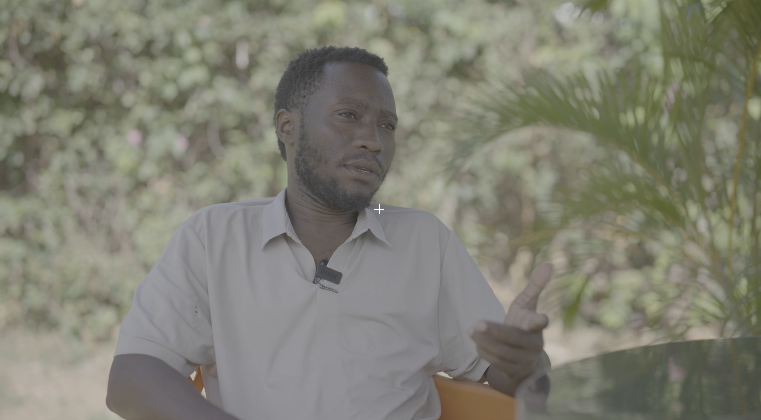
WorldFish analyst Japhet Tembo estimates women are about 2.4 per cent of Kenya’s counted fishers, and says gleaning goes uncounted
The count of 14,000 is consistent with published work citing the 2022 survey. The earlier 2014 survey counted 167 women among 12,915 fishers, or 1.3 per cent.
A 2024 study notes that Kenyan authorities put fisherwomen at under 2 per cent of fishers, while globally women are about 40 per cent of the small-scale fisheries workforce.
The gap is definitional. A “fisher” in the census is someone with a boat or a line. Women walk the reef.
“Gleaning” is, in Tembo’s phrase, a hidden part of the system: it does not enter BMU data logs or the national catch assessment, so “their data go uncounted in terms of the national statistics” and planners have nothing to plan with.
Tembo says the Fisheries Management and Development Act of 2016 covers small-scale fisheries and gives BMUs the mandate to manage local marine resources.
“The policies are there but the problem is the implementation,” he says.
The legal position of cowrie collection is also unclear. The 2024 Marine Fisheries Regulations allow subsistence fishing by foot, capped at five kilogrammes of fish a day, but bar subsistence fishers from commercial fishing or fish trade.
Dr Juliet Karisa, a marine scientist at the Kenya Marine and Fisheries Research Institute (KMFRI), says existing policy forbids exporting cowrie shells or taking them from marine protected areas. It only allows collection for personal use, not trade.
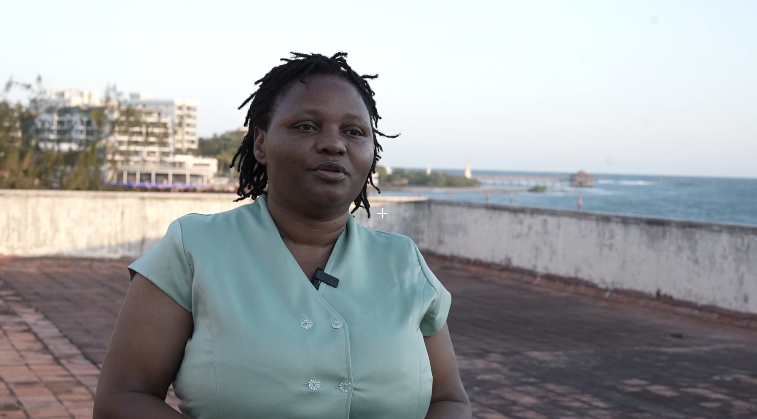
Dr Juliet Karisa of KMFRI says there's a need for policy review.
“Such policies were made at a time when there was a lot of that resource, and they need review,” says Dr. Karisa
Yet Saumu Mkani tells us a license exists and collectors are asked for it, and the BMU Regulations list shell collectors as members.
What a collector’s license actually permits is a question we have not been able to settle.
Where the freezers went
The most consistent complaint from fish traders was about cold storage. Salama Rajab has sold fried fish at Kijangwani for 26 years.
When the catch is big, she said, she cannot buy in bulk because she has nowhere to keep it, so she buys a little, fries it, sells it, and returns the next day.
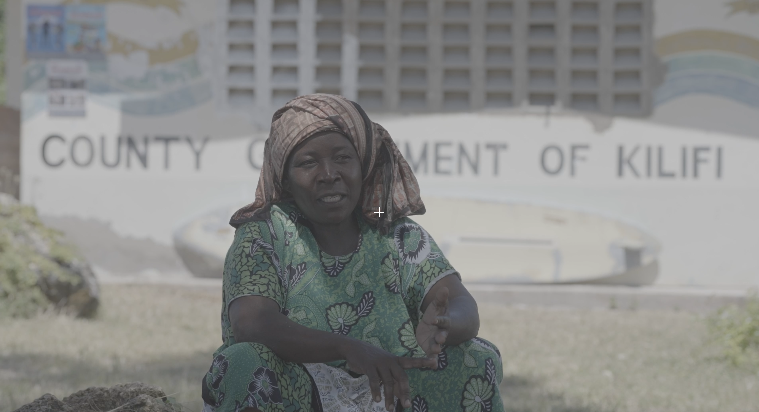
Salama Rajab says she cannot buy in bulk because she has nowhere to store it
Mwanaisha Hassan, who has traded for six years, said the traders there have no cool boxes or freezers and carry fish in basins.
Salama said they held a meeting where traders asked for freezers and for tents and chairs to hire out. They were told it was fine.
“Until now we have seen nothing. Kuruwitu people got, Mwanamia people got. Here at Kijangwani not one woman has got,” she said.
The officials’ account is different. Kingi said the government, with NGOs, has bought freezers and cooler boxes for women, is building shades, and has put fish depots at Mtwapa, Kuruwitu and Kidongo to cut post-harvest losses.
He said the boxes “are specifically for women”.
Both can be true: support may exist and still not reach Kijangwani. What decides who gets it is the mechanism.
Kingi said funding goes to groups, not individuals, and that groups typically have 15 to 30 members, so women outside a group feel left out.
Bi Dala described the same system from the BMU side: “Kanamai BMU has 13 groups, maybe four won support, and for some programmes you have to write a proposal”.
“Winning,” she said, “depends on your sharpness”.
Kingi himself named illiteracy as a main barrier to accessing funds, citing the difficulty some traders have even obtaining national IDs.
Bi Dala added a second grievance: kit arrives without anyone asking what is needed.
“Nobody asks what size of freezer or net, or what kind of boat. You will just be brought a boat you did not expect,” she said.
Who hears about the meetings
All three collectors said no official had ever called a meeting of shell collectors.
Mama Margaret said that when the sea-going fishers are summoned, the women turn up anyway:
“We go to a meeting that does not concern us, because we have never been called. We are not recognized,” she said.
Saumu said she is a Kanamai BMU member and that after a leg injury left her housebound for a year, she saw no contribution from the BMU, only a few individual visits.
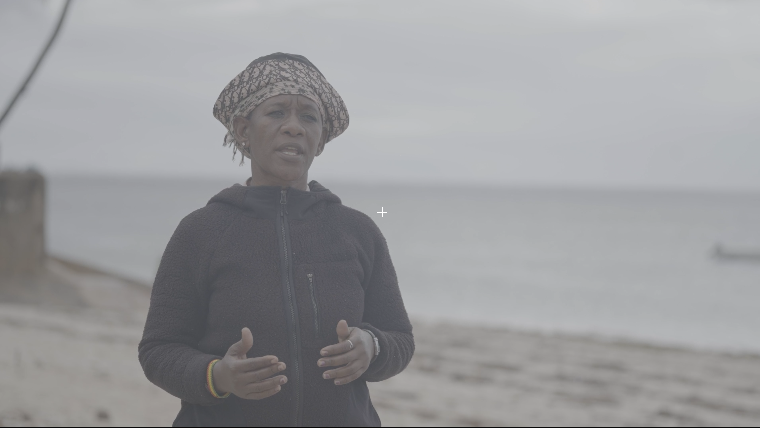
Saumu Mkani says she saw no contribution from the BMU during the year a leg injury kept her at home
Salama, also a BMU member, said she has never been properly told what membership means, and that complaints raised in meetings are met with promises to reply that are never kept.
Bi Dala’s position is that complaints about communication come from non-members. “Members all know,” she noted.
Nzai offered another explanation. “Shell collectors often sit under a tree and never reach the BMU office where notices go, and when he is asked to send five or ten women to a training, jealousy follows.”
Tembo made the structural point: “only those that have information will benefit.”
Landing sites that are not landing sites
The cold stores the women ask for need somewhere to stand.
Bi Dala says the Kanamai BMU; has no landing site, no office, no access road, and keeps its books at a member’s house.
Providers of water and power, she says, demand a title deed before they connect. She says the BMU has asked its MP and local companies for even a container to use as an office, in vain.
Murage says that out of 104 BMUs on the coast, only about seven or eight sites are gazette. This, he says, leaves most BMUs outside legally defined jurisdiction.
The BMU Regulations give a BMU authority over its landing station. The 2014 frame survey recorded 197 landing sites on the coast.
On October 9 2026, President Ruto told fishermen at the Agriculture & Food Systems Transformation Summit in Nairobi that all 41 landing sites along the coastline have been gazetted. The President’s account doesn’t match the 104 BMUs Murage counted.
Natural Justice, which sought the state’s landing-site survey, says many sites are dysfunctional or captured by outside interests.
The other shore: women who farm fish
Not all is gloom for women. Grace Fondo and Kibibi Kadenge farm tilapia in ponds supplied by a government project.
Kibibi and Grace says that 80 per cent of their group members are women. They argue that their income has changed, their households improved, school fees are paid, and diets thrived.
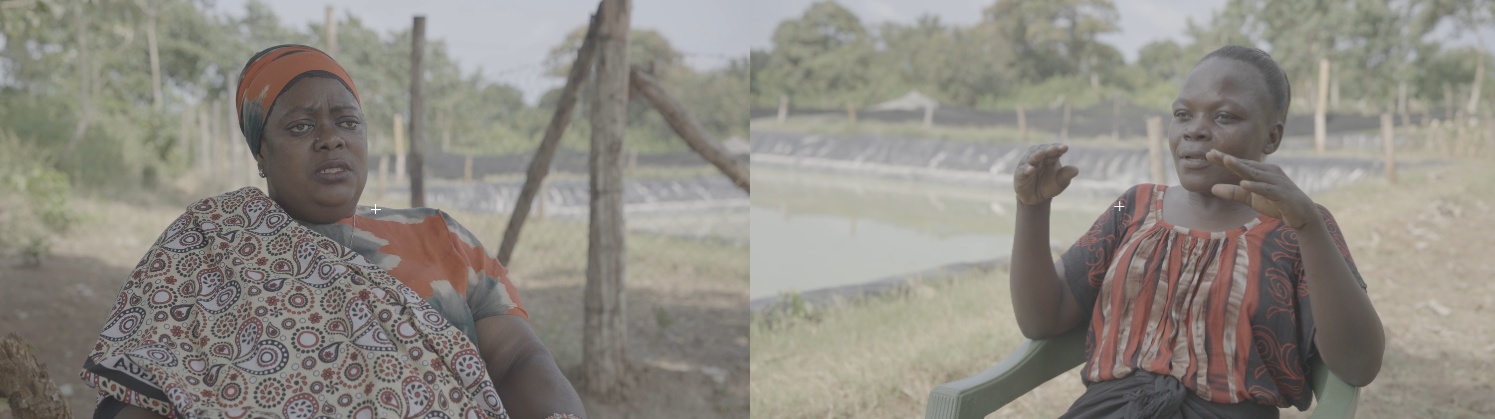 Grace Fondo and Kibibi Kadenge and Grace Fondo say income from fish farming has helped pay school fees and put food on the table
The duo says that the support ended early. Grace says the group was shown feed ratios once, when the fingerlings arrived, and was told the feed supplied would expire after two years.
She says she has never had specialized training. One morning she found the fish gasping at the surface and she called an officer, who failed to pick up her call.
A local member advised opening the water; two hours later the fish had recovered. Kadenge said they were promised teachers who never came, and that the group farms “with our natural wits.”
Grace recalls that at one time; a senior official’s visit was announced, guests including foreigners were invited, and then the visit was abruptly cancelled that afternoon.
“It is as if we exist and do not exist,” she laments. She wants a market, training and loans.
Neither group belongs to a BMU or holds a license, and Grace says she knows of no policy that applies to them.
Kingi says the department can advise but cannot supply a water source. “We are a department, and funding is the main gap,” he says.
Yet The Star’s report of PS Njagi’s plan describes aquaculture as the main growth engine, with output projected to rise from 168,000 to over 450,000 tons.
Grace and Kabibi, are standing at the centre of that plan, with no extension service in reach.
Children in the water
Mama Margaret argues that her daughter is not the only child who ventures into the dangerous trade. Many school pupils, she says, join their mothers after class and at night.
Under Kenyan law, the Constitution of Kenya Article 53(1)(d); and the Children Act 2022, Article 53section 18), a child may not be subjected to hazardous labour or work that interferes with education.
BMU membership begins at 18.
“We don’t encourage kids. It’s not according to the law. They are not supposed to be doing those activities. So, when we encounter such cases, we discourage them, and we take action,” says Kingi.
He adds that: “Maybe those are just a few selected cases when we don’t have information, but when we get such information, kids are not allowed to be doing those activities, only adults.”
Nzai says BMUs keep guard and child labour is prohibited. However, in practice a mother arrives with a child carrying the bucket.
The law and the tide meet at a kitchen table: for Margaret, the child comes because there is no other money for school.
Safety is the other risk. Collectors described the tide coming in unseen in the dark, with fishers whistling a warning from the reef, and two women rescued by boat after staying too long.
Tembo says women who cannot swim and have no vessel or life jackets are exposed to danger. The BMU Regulations make safety and rescue a BMU duty.
What officials say
The county and BMU leaders reject the idea that women are being left out, and some of the evidence supports them.
Kingi says fisheries policy is working and the catch is recovering. He says women are not excluded and that the programmes are “an equal opportunity” that “depends on your hard work”.
He says that at Kuruwitu women who accessed loans now run two fish butcheries. He argues that mama karanga are not low earners, since fishers believe traders profit more, and that women’s absence from the sea itself is “not a matter of governance or policy but tradition”.
He says every BMU’s accounts are audited and committees monitor spending.
Nzai says the old taboo about women on boats is fading. “Women now do coral restoration, two data-collector posts went to women after a competitive vetting, and a woman who beat men for the chair of Kuruwitu’s protected area now sits above him on that area’s decisions.”
Nzai says women must themselves decide to go to sea and that BMUs can then find trainers.
Bi Dala says the number of registered shell collectors at Kanamai has risen from 15 or 20 to 67 since she took office.
Murage pointed to Jimbo and Vanga in Kwale, where women began by processing landed fish, organised into groups, bought boats, and now out-earn men.
Dr. Juliet says she has watched women in Lamu go from the basics to winning grants and speaking in conferences in Madagascar and France.
But the officials’ own evidence points to the barrier that tradition does not explain.
Murage says income in fisheries tracks investment: catch is shared among boat, engine, gear and crew, and dealers take the biggest mark-up, so people who own the assets get the most.
It is “not an equal playing field”. Women are well placed as traders but cannot buy the boats, engines or freezers, because banks want security and most fishers have none.
So Kingi’s point that mama karanga earn well, and Salama’s that she cannot buy more than she can fry daily, are the same fact seen from two ends: capital and storage decide.
What the women are asking for
The requests are specific. Collectors asked to be recognised and called to meetings, and for a way out of the sea: businesses to start, or a job for their children after completing school.
Fish traders asked for freezers, cool boxes, standard prices from fishers and, if possible, a boat of their own.
Grace and Kibibi asked for teachers, loans, a market and gloves, aerators or water-treatment help.
Bi Dala wants the government to lower license fees, to ask what is needed before delivering it. She says there should be a follow up on whether something donated is used for its intended purpose.
The experts converge on a short list. Tembo wants gleaning to be counted and sex-disaggregate fisheries data.
Dr. Juliet Karisa champions for finance, which she says is the best empowerment tool.
Murage points at a review of the Fisheries Management and Development Act, now under way, public funding for BMUs, gazettement of landing sites, and “thinking outside the reef” so the effort goes to boats and skills that can reach unfished waters.
Kingi says there is need for alternative livelihoods to ease pressure on the reef.
The verdict
Is the Blue Economy leaving Kilifi’s women behind? On this evidence, the answer depends on which women and which part of the economy.
Women are not shut out by law. They hold committee seats, form savings groups, run butcheries and farm fish.
But the programmes that carry the strategy’s promises run through channels that favour the literate, the organised and the already informed: groups, proposals, meetings and gazetted sites.
Women like Margaret, with the least capital, the cowrie gleaners; are not counted, are not clearly licensed. They are not called, and continue working with in the dark with their children.
Mama Margaret clings to the hope in the Blue Economy’s Strategy 2030, target growth of Ksh 350 billion. She says: “I pray that my daughter finishes school and gets a job. If she finds work, she will free me too: I will not go into the sea again,”
Until the target becomes a reality on the ground, she will continue scratching the sandy beaches with her torchlight, dreaming and hoping.
This publication was produced with support from Mbegu Fund under the SAFIRI Programme, funded by the European Union.