The debate over whether BMUs should become commercially viable entities may be missing a more fundamental question: what were these community institutions created to achieve in the first place?
By Allan Kai
There are moments when a seemingly ordinary question opens the door to a much bigger conversation.
In Kenya's fisheries sector, one such question is now being asked about an institution that has been at the centre of community participation in fisheries management for nearly two decades:
What exactly are Beach Management Units (BMUs) supposed to be?
Are they community institutions for fisheries governance? Are they vehicles for co-management between government and fishing communities? Are they economic enterprises? Should they have business arms? Could they eventually function as cooperatives? Or have they gradually become an administrative structure whose original purpose has been obscured by years of policy changes, projects, personalities and institutional restructuring?
These questions go to the heart of how Kenya manages one of its most important natural resources – and how much power fishing communities actually have over decisions affecting their livelihoods.
In my rounds on social media I came across a debate by some senior fisheries practitioners, with one party questioning whether the original objective of BMUs had remained intact.
The questions were blunt: Has the objective of BMUs remained on course? Did the push to harmonize fisheries management across different water bodies move the model away from its original purpose? Did "co-management" acquire different meanings depending on who was interpreting it? Is a single BMU model appropriate for every water body in Kenya? And are government agencies themselves working from the same understanding of what BMUs are meant to do?
Perhaps most importantly: who remembers why the system was created in the first place?
From participation to co-management
The idea behind BMUs is that fisheries cannot be effectively managed from government offices alone.
Fishers know the waters. They know the seasons, the fishing grounds, the changes in fish behavior and the pressures affecting their livelihoods. Government, meanwhile, possesses statutory authority, technical expertise and responsibility for conservation and enforcement.

A group of fishers getting ready to go at sea. Photo: Courtesy
Co-management attempts to bring these two together.
That philosophy is consistent with the broader principles of the Food and Agriculture Organization's 1995 Code of Conduct for Responsible Fisheries, which emphasizes participation, consultation and cooperation in fisheries governance. The Code encourages governments to involve fishing communities and other stakeholders in developing and implementing responsible fisheries management.
FAO's guidance on fisheries rights goes even further, describing co-management as involving management rights – the right of stakeholders, including fishers, to participate in managing the fishery.
A community can attend meetings, sign registers, receive training and sit on committees without necessarily having meaningful influence over the decisions that govern its fishery.
The original promise of co-management was therefore bigger than simply creating another committee at the beach.
It was about changing how fisheries governance itself was done.
Kenya institutionalized the idea
Kenya formally established BMUs through the 2007 Fisheries (Beach Management Unit) Regulations. Those regulations have since been repealed and replaced by the Fisheries Management and Development (Beach Management Units) Regulations, 2024.
The current law gives BMUs a remarkably broad mandate.
Among their stated objectives are strengthening management of fish landing stations and fisheries resources, supporting sustainable fisheries development, improving planning and resource management, promoting democratic participation and self-reliance, building capacity for effective co-management, resolving conflicts and strengthening co-management through BMU networks.
In other words, the law describes a BMU as an institution of fisheries governance.
The regulations also give BMUs responsibilities relating to the implementation of fisheries management plans, collection and transmission of fisheries data, patrols and participation in co-management arrangements.
At higher levels, BMU networks are expected to advocate for sustainable fisheries policies, develop codes of practice, support the fight against illegal, unreported and unregulated fishing, represent BMUs before government, mobilize resources, resolve conflicts and participate in developing and implementing co-management plans.
That is a considerable governance responsibility.
Which brings us back to the question:
If BMUs are fundamentally governance institutions, where does business fit in?
The business question
One side of the debate argues that BMUs need to become economically viable.
The suggestion has reportedly been misunderstood as a proposal to turn BMUs themselves into cooperatives.
That interpretation has been rejected.
The argument instead is that BMUs can have business wings or cooperative structures that run commercial activities on behalf of the BMU.
The distinction is important.
A BMU could remain the governance institution while a separate commercial arm undertakes income-generating activities.
The analogy offered in the discussion was that of an NGO with a consulting enterprise or a university with a commercial enterprise.
This is not necessarily incompatible with co-management.
In fact, economic sustainability may be essential if community institutions are expected to perform increasingly demanding governance functions.
The problem begins when commercialization becomes an end in itself.
A fishing community institution that becomes financially successful but loses its accountability to fishers may have solved one problem while creating another.
And there are even bigger questions:
Who owns the business? Who controls it? Who benefits? Who audits it? And who prevents the commercial arm from eventually becoming more powerful than the governance structure it was created to support?
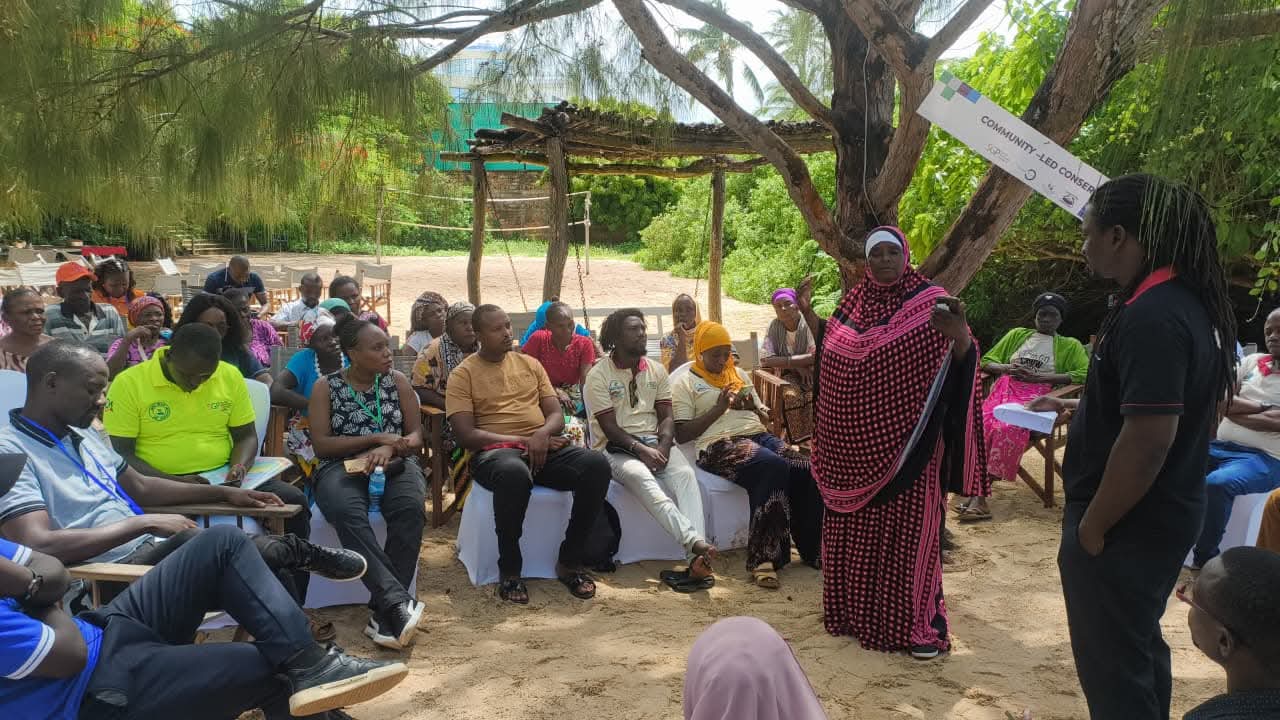
BMU members at Kuruwitu, Kilifi interacting with media practitioners during a recent event organized by Blue Radio Kenya and Media for nature. Photo: KD Photography
The "middle unit" question
The exchange also revealed another important issue.
One participant described the BMU as the "middle unit" of co-management, with a hierarchy running from BMU committees and executives to assemblies, county BMU networks and ultimately wider water-body and national structures.
The distinction is significant.
If the BMU is merely the lowest administrative structure in a much larger governance architecture, then strengthening the institution cannot mean looking only at what happens at an individual landing site.
The network matters.
The relationships between BMUs matter.
The relationship between BMUs and county governments matters.
The relationship between county governments and the Kenya Fisheries Service matters.
And for shared water bodies, regional institutions matter too.
This is particularly important in Lake Victoria, where fisheries transcend national and county boundaries and require regional coordination.
It is also why institutional memory becomes so important.
What happened to the institutional memory?
Perhaps the most revealing part of the conversation was not about cooperatives or business models.
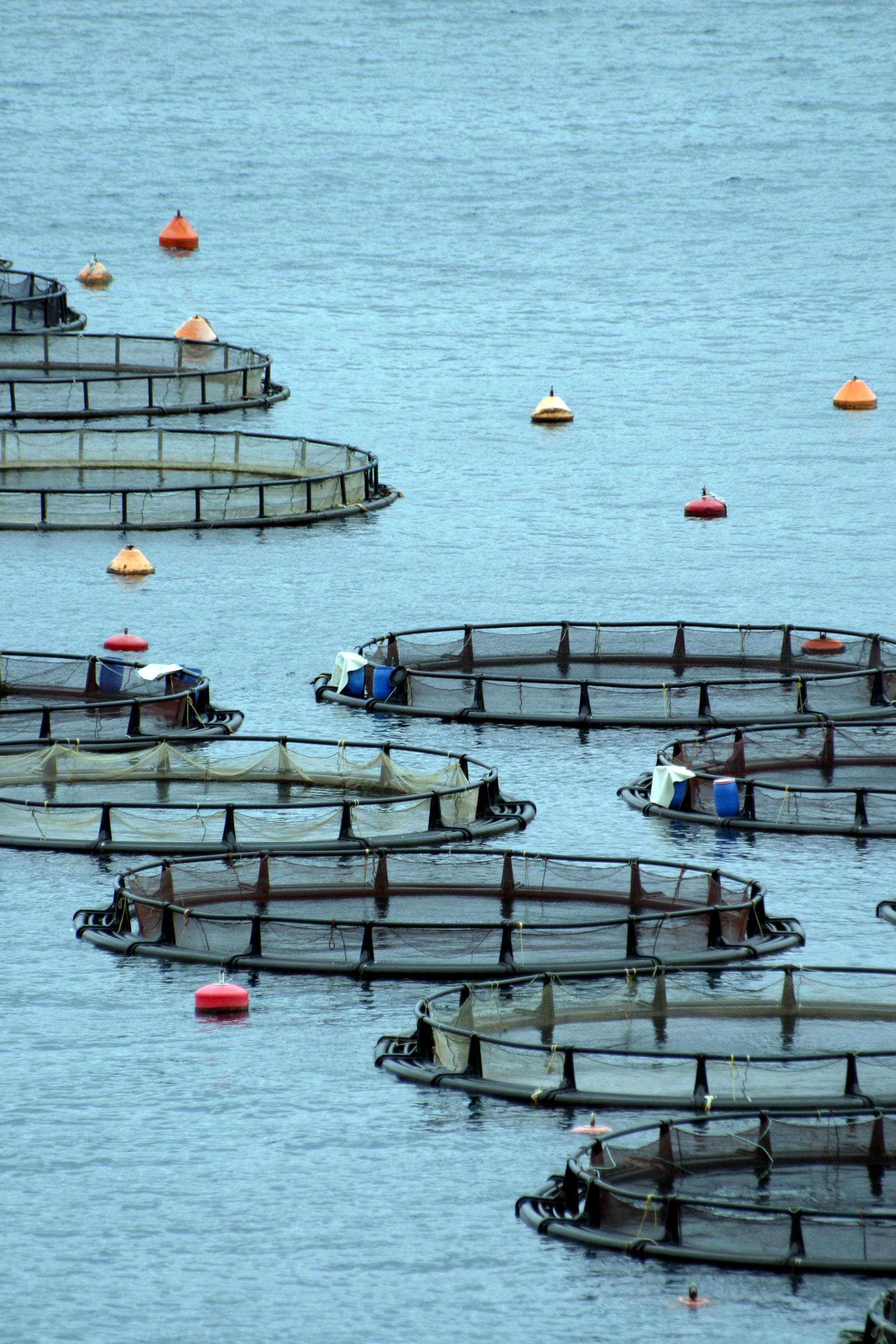
Cage fish farming, popular on Lake Victoria and other inland water bodies. Photo: Courtesy
It was about documents.
One participant recalled that ideas about BMU networks, including the architecture of regional representation, had already been discussed during the development of draft BMU network regulations more than a decade ago.
The recollection was that the Lake Victoria regional structure had been important in Kenya's representation within the Lake Victoria Fisheries Organization (LVFO), even as national-level BMU structures evolved.
Then came the uncomfortable observation:
Some of this history may simply have disappeared from institutional memory.
The response was telling: perhaps it was time for the wider fisheries department to revisit the idea of a central library where knowledge is deposited for continuous and progressive planning.
Fisheries policy is built over decades. Projects come and go. Development partners arrive and leave. Consultants produce reports. Regulations change. Officials retire. Political administrations change.
But fish remain.
And so do the communities whose livelihoods depend on them.
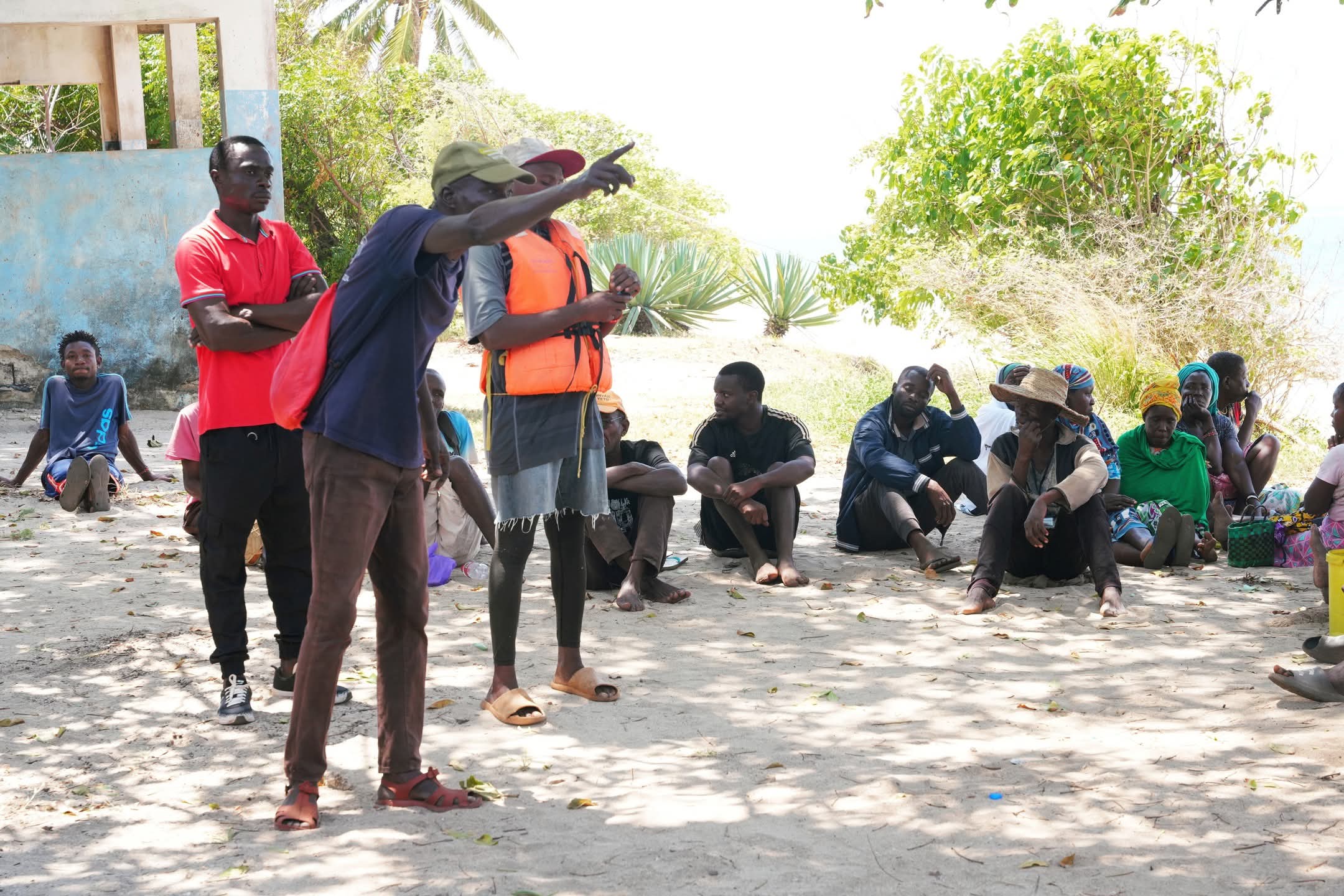
BMU members during an information disemination event organized by Oceans Alive Kenya. Photo: Oceans Alive Kenya FB
If each generation of fisheries managers has to rediscover what the previous generation learned, the sector risks repeatedly starting from zero.
The project problem
The BMU model in Kenya is often associated with fisheries management interventions around Lake Victoria and the wider evolution of community participation, including programmes supported by development partners.
The original question raised in the discussion was whether the model's development through specific fisheries management plans and projects was subsequently altered when it was cascaded into a national framework.
A model developed around the ecological, social and institutional realities of one water body cannot automatically be assumed to work identically elsewhere.
Kenya's fisheries are extraordinarily diverse.
Lake Victoria is not Lake Turkana.
Lake Turkana is not the Indian Ocean.
The Indian Ocean artisanal fishery is not a small inland landing site.
The social structures, fishing methods, markets, ecological pressures, cross-border dynamics and relationships with government are different.
Yet policy systems often prefer uniform structures because uniformity makes administration easier.
The danger is that administrative harmonization can become institutional homogenization.
A standard structure may be useful for accountability and national policy.
But standardization should not erase local realities.
The question should therefore not be whether Kenya needs one BMU framework.
It should be:
How much of the framework should be standardized, and how much should communities be allowed to adapt to their particular fisheries?
Does every water body need the same BMU model?
Kenya's 2024 regulations recognize co-management areas and joint co-management areas, including situations where multiple BMUs and counties share fisheries resources. They also establish BMU networks at ward, sub-county, county, water-body and national levels.
That is an attempt to accommodate complexity.
But a legal hierarchy does not automatically produce effective governance.
A BMU operating on the coast may have to deal with artisanal marine fisheries, tourism, mangroves, coral reefs, marine protected areas and cross-border fishing pressures.
A BMU on Lake Victoria operates within a completely different ecological and economic environment.
A cage-farming community introduces another layer of complexity.
So perhaps the question should be whether Kenya's fisheries governance architecture is sufficiently adaptive.
The law can establish the skeleton.
But communities need enough flexibility to build the muscles around it.
And then there is government
One of the most uncomfortable questions in the conversation was whether all government agencies are reading from the same page when it comes to BMUs.
This deserves more attention.
Kenya's fisheries governance is no longer the responsibility of a single institution.
National government agencies, county governments, fisheries authorities, research institutions, environmental agencies, regional bodies and development partners can all have roles that intersect at the landing site.
The 2024 regulations themselves require co-management plans to specify the roles of BMUs, county fisheries directors, the Director-General, fisheries research institutions and other stakeholders.
That sounds orderly on paper.
But fisheries governance is ultimately experienced at the beach.
If one government institution sees a BMU primarily as a community enforcement mechanism, another sees it as an administrative structure, another as a development partner entry point and another as a potential commercial organization, confusion becomes inevitable.
And the fishers are left navigating the contradictions.

Fisher posing for a photo. Photo: Oceans Alive Kenya FB
A BMU cannot be everything to everyone
There is a temptation in development policy to load community institutions with responsibilities:
Management, Enforcement, Data collection, Conflict resolution, Conservation, Business, Representation, Fundraising, Community development, Environmental monitoring, and Political advocacy.
The more responsibilities placed on a BMU, the more important it becomes to ask whether it has the resources, capacity and authority to deliver them.
The 2024 regulations expect BMUs to support implementation of co-management plans and even participate in patrols in designated areas.
But enforcement is expensive. Data collection requires skills. Business requires capital and financial management. Governance requires accountability. Conservation requires scientific knowledge.
It is unrealistic to expect a voluntary or community-based institution to perform all these functions indefinitely without a sustainable financing model.
This is where the business argument becomes legitimate.
But commercialization must strengthen governance rather than replace it.
So, have BMUs lost their way?
There is probably no simple yes or no answer.
The fact that the debate is happening may itself be evidence that the BMU system has reached a point where it needs reflection.
The original philosophy remains relevant: fisheries management should not be imposed entirely from above.
But two decades of implementation inevitably change institutions.
BMUs have acquired new responsibilities. Kenya has undergone devolution. The fisheries economy has changed. Aquaculture has expanded. Climate and ecosystem pressures have intensified. Markets have evolved. Digital technology has transformed access to information. And the regulatory framework itself has been revised.
The challenge, therefore, may not be to return BMUs to an imagined "original" form.
It may be to ask whether the institution has evolved deliberately or accidentally.
Perhaps Kenya needs a BMU audit – not another restructuring
Before another committee is created, another project launched or another restructuring exercise proposed, Kenya's fisheries sector could benefit from something much more fundamental:
an institutional stocktaking of the BMU system.
What was the original objective?
What has worked?
What has failed?
Which responsibilities have been added?
Which have disappeared?
What did earlier projects learn?
What recommendations were made but never implemented?
Which regulations have changed?
What do fishers themselves believe BMUs should become?
What do county governments think they are?
What does the Kenya Fisheries Service think they are?
What does the law say they are?
And, critically, are those answers the same?
Perhaps Kenya needs a national repository of fisheries knowledge where the accumulated experience of practitioners, researchers, communities and institutions is preserved rather than lost when people retire or projects end.
Because one of the most dangerous things that can happen in public policy is not getting something wrong.
It is forgetting that you have already tried it before.
The question beyond the cooperative debate
The argument over whether BMUs should have cooperative business wings is therefore only the surface of a much deeper conversation.
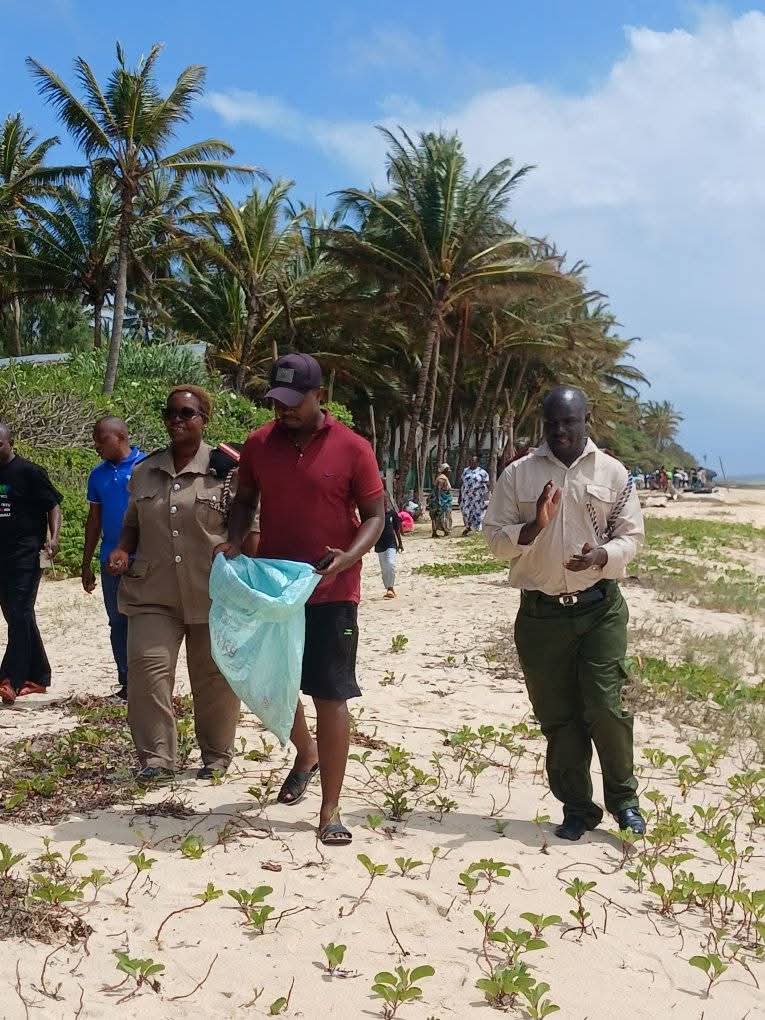
Community and government representatives taking part in a beach clean-up event at Kuruwitu, Kilifi. Photo: Courtesy
The real question is:
What should a Beach Management Unit be in Kenya in 2026 and beyond?
Because when an institution has multiple interpretations, the person with the greatest power usually gets to decide what it means.