There is a particular kind of frustration that comes with watching potential go to waste.
For years, Lamu Port has been that frustration made physical, a deep water facility sitting on one of the most strategically positioned coastlines in the Indian Ocean, largely underutilised while the region it was built to serve continued moving goods the hard way, through congested routes and overstretched infrastructure.
But something is shifting. And the shift is worth paying close attention to.
The War That Woke Up Lamu
It took a crisis on the other side of the world to remind East Africa what it had been sitting on.
The ongoing hostilities in the Persian Gulf and the Red Sea have effectively closed traditional maritime routes that global shipping has depended on for decades. Tanker traffic through the Strait of Hormuz has declined sharply. Cargo that would ordinarily move through the Arabian Gulf is being rerouted and Lamu, with its deep water berths and relative security, has emerged as one of the most viable alternatives.
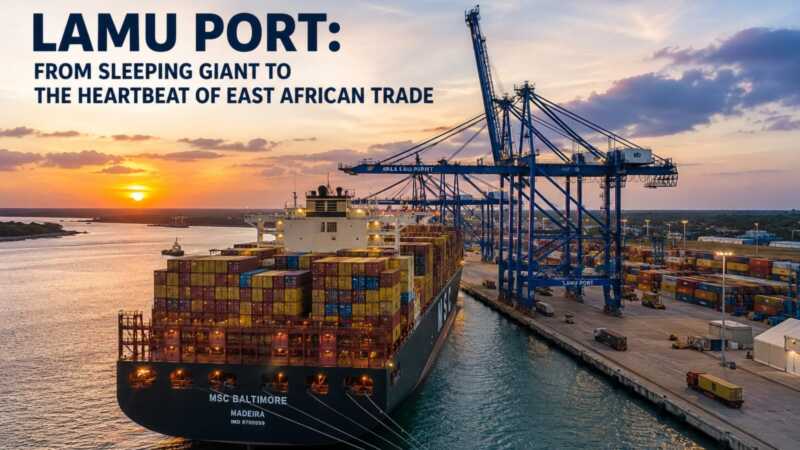
In early 2026, the port handled over 120 vessels in just four months. The MV Baltimore Express, the largest ship ever to call at an East African port, docked at Lamu, a vessel too large for shallower ports like Mombasa to accommodate. That single arrival said something important: Lamu can do what no other East African port currently can.
But here is the honest truth that needs to be said clearly.
This boom is borrowed. It is a product of external crisis, not internal development. The moment regional stability returns to the Gulf, rerouted cargo finds its way back to familiar lanes. If Kenya is serious about Lamu, the work of building its permanent strategic value cannot wait for the next geopolitical disruption to do the marketing.
The real benefit and potential of Lamu, for the people of Kenya and East Africa, remains largely untapped.
The LAPSSET Promise and What Actually Happened
To understand where Lamu stands today, you have to reckon honestly with where it was supposed to be.
The Lamu Port South Sudan Ethiopia Transport Corridor, LAPSSET, was conceived as one of Africa's most ambitious infrastructure projects. A 32 billion dollar vision of ports, railways, pipelines, resort cities and highways that would unlock Kenya's northern frontier and connect landlocked neighbours to global trade. When it was announced, it generated genuine excitement. Lamu was going to be transformed. Communities were going to benefit. A new economic corridor was going to be born.
What followed was a decade and a half of delays, underfunding, political inconsistency and broken promises, particularly to the local communities in Lamu who were asked to make way for a project that moved far slower than the sacrifices it demanded. Land compensation disputes remain unresolved. The railway connecting Lamu to Addis Ababa and Juba exists largely on paper. The resort cities are a distant aspiration.
LAPSSET did not fail entirely, the port exists, berths have been built, and some road infrastructure is operational. But the gap between what was promised and what was delivered is wide enough to drive genuine scepticism about what comes next.
That scepticism is understandable. It should not, however, become permanent.
Because the underlying logic of LAPSSET, that East Africa needs an integrated, efficient northern corridor connecting the Indian Ocean to landlocked economies, has not changed. If anything it has become more urgent.
Bigger Than LAPSSET Ever Imagined
Here is where the conversation needs to shift from looking backwards to looking forwards.
Lamu's potential is not limited to the originally intended LAPSSET region. The geography, the deep water capacity, and the growing economic weight of East and Central Africa position it to serve a far larger catchment, the Democratic Republic of Congo, Ethiopia, South Sudan, Uganda and beyond.
The proposed Great Equatorial Land Bridge, a seamless trade link from Lamu on the Indian Ocean to Douala on the Atlantic, is not science fiction. It is a logical infrastructure response to the reality of a continent whose internal trade is growing faster than its cross border infrastructure. If realised, it would dramatically reduce transit distances for continental commerce and position Lamu not as a regional port but as a genuinely intercontinental logistics node.
The economic case for this is straightforward. East Africa's economies are growing. Trade, both imports and exports, is set to expand significantly over the next two decades. As Africa's youth population matures into the workforce, more investors are going to move into mining, industrial agriculture and manufacturing across the region. Kenya alone is positioning itself as a hub for critical minerals including rare earths, titanium and niobium. Industrial agriculture projects are being developed to shift the region from net importer to value added exporter. Manufacturing in textiles, leather and pharmaceuticals is gaining ground in SEZ environments across multiple countries.
All of that economic activity needs infrastructure. Efficient, reliable, cost effective infrastructure that can move goods from point of production to point of consumption, regionally and globally.
Lamu is positioned to be at the centre of that infrastructure story.
But positioning alone does not build a port city. Investment does.
The Incentive Question
The Kenyan government has begun moving in the right direction.
The Lamu Special Economic Zone, covering 12,000 hectares, offers tax holidays, 100% investment deductions and duty exemptions on imported machinery. The Kenya Ports Authority has put forward 60 days of free storage for transshipment cargo and a 40% reduction in handling charges. Future anchor projects include a liquid bulk terminal, an agribulk terminal and an oil refinery at Isiolo.
These are meaningful signals. But signals need to be backed by consistent, predictable policy execution, which has historically been LAPSSET's weakest link.
The government needs to go further in incentivising the project to attract both international and regional investors. The Dangote example is instructive here. Africa's richest man has already signalled interest in investing in the region, his proposed oil refinery at Mombasa, valued at up to 17 billion dollars, is the most significant industrial investment signal this coast has seen in a generation. That level of investor interest does not arrive by accident. It arrives when the commercial logic is clear, the infrastructure is credible and the policy environment is predictable enough to justify the risk.
Lamu needs to create those same conditions, deliberately and urgently.
The private sector will not wait indefinitely for governments to sort themselves out. Capital is mobile. Investors with the appetite for corridor scale logistics infrastructure are already looking at competing locations. Ethiopia's Berbera corridor through Somaliland. Dar es Salaam's expansion. Djibouti's continued dominance of Ethiopian trade. The window for Lamu to establish itself as the preferred northern corridor option is open, but it will not stay open forever.
The Electric Mobility Advantage Nobody Is Talking About Enough
There is one structural advantage available to whoever builds the logistics infrastructure of this corridor that is not being discussed loudly enough.
Africa is at a unique juncture. Unlike Europe or North America, which built their logistics industries on decades of diesel dependent infrastructure and now face the enormous cost of transitioning, East Africa has the opportunity to build its logistics backbone on electric mobility from the ground up.
Kenya already generates over 90% of its electricity from renewable sources. Ethiopia has banned the import of internal combustion engine vehicles entirely. The cost of running electric freight and last mile delivery fleets, powered by locally generated renewable energy, is structurally lower than diesel operations and the gap widens every year as fuel import costs fluctuate with global markets.
A logistics company building operations along the Lamu corridor today that bets on electric fleet infrastructure is not just making an environmental choice. It is making a cost structure decision that compounds over time into a significant competitive advantage over operators still dependent on imported fuel.
Digital logistics platforms like Lori Systems and Kobo360 are already demonstrating that technology driven freight optimisation can reduce operational costs by up to 20%. The combination of electric mobility, digital optimisation and early corridor positioning is a set of advantages that will be difficult to replicate once the market matures.
The question is who moves first.
The Risks Are Real. The Growth Is Inevitable.
It would be dishonest to write about Lamu's potential without acknowledging the risks clearly.
Regional instability remains a genuine concern. Al Shabaab's operational presence in the broader region is not a theoretical risk, it has historically affected investment confidence and supply chain reliability along Kenya's northern corridor. Land compensation disputes that LAPSSET left unresolved continue to create friction and community resentment that, if unaddressed, slows or derails development. Unharmonised axle load standards at regional borders still create delays that undermine the efficiency gains that corridor infrastructure is supposed to deliver.
These are not small problems. They require sustained political commitment, security investment and community engagement that goes beyond ribbon cutting ceremonies and investor conferences.
But here is what the evidence suggests: the growth of this corridor is not a question of if. It is a question of when and who.
The economic drivers, growing regional trade, expanding manufacturing and mining activity, a young workforce entering the job market across East Africa, the rerouting pressure from global maritime disruptions, are structural, not cyclical. They do not reverse when a news cycle moves on.
What changes is who captures the value.
The Early Mover Advantage
In every economic corridor that has matured into a genuine trade artery, Rotterdam, Singapore, Dubai, Mombasa itself, the companies that established themselves early, before the infrastructure was complete and the risk was fully priced in, took a disproportionate share of the long-term market.
They absorbed the early friction. They built the relationships. They learned the routes and the regulatory environments and the community dynamics that latecomers have to pay to understand. And when the volumes arrived, they were already positioned to capture them.
A forward thinking logistics company that is willing to establish itself now across the Lamu corridor, with connectivity into the DRC, Ethiopia and South Sudan, is not just making a logistics investment. It is planting a flag in what could become one of the most significant trade arteries on the continent.
The infrastructure will eventually come. The railway will eventually be built. The SEZ will eventually fill with industrial activity. The question for serious investors is whether they want to be the ones who shaped how that corridor operates or the ones who arrived after it was already someone else's territory.
The companies that will take the lion's share of East Africa's logistics future are the ones making decisions today that most people consider premature.
History tends to call those people pioneers.
What Needs to Happen Now
The path from Lamu's current moment of crisis driven activity to its permanent strategic relevance requires movement on several fronts simultaneously.
The government must resolve outstanding land compensation disputes, not eventually, but now. Community trust is not a soft issue. It is operational infrastructure. A port city that sits in tension with its surrounding communities is a port city managing a permanent risk that erodes investor confidence over time.
The railway link to Addis Ababa and Juba must move from planning document to active construction. Road connectivity through the Isiolo Moyale highway is operational, but a heavy reliance on trucking over long distances limits the corridor's capacity and cost competitiveness. Rail changes the economics fundamentally.
The SEZ incentive framework must be communicated consistently and enforced predictably. Investors do not require perfection. They require certainty. The rules must be the same on the day the investment is made as they are five years later.
And regional governments, Kenya, Ethiopia, South Sudan, Uganda, DRC, must align on the harmonisation of border procedures, axle load standards and transit regulations that currently add days and cost to corridor movements that should be seamless.
None of this is easy. All of it is necessary.
The Window Is Open
Lamu Port is no longer a white elephant. The MV Baltimore Express docking in its berths proved that. The 120 vessels in four months proved that.
But a crisis driven boom is not a strategy. Kenya needs to convert this moment of external validation into permanent internal development, with the policy consistency, the infrastructure investment and the investor incentives that turn a sleeping giant into a genuine continental logistics hub.
The potential is real. The geography is irreplaceable. The economic tailwinds are structural.
What is needed now is the will to build and the investors, operators and partners willing to move before the window narrows.
East Africa's logistics future is being written. The question is who is holding the pen.
Blue Radio is Kenya's only dedicated blue economy radio station, covering maritime, coastal and ocean economy stories that shape the lives of communities along Kenya's coast. Tune in at www.blueradio.co.ke
Follow us on LinkedIn, X and Facebook @BlueRadioKE